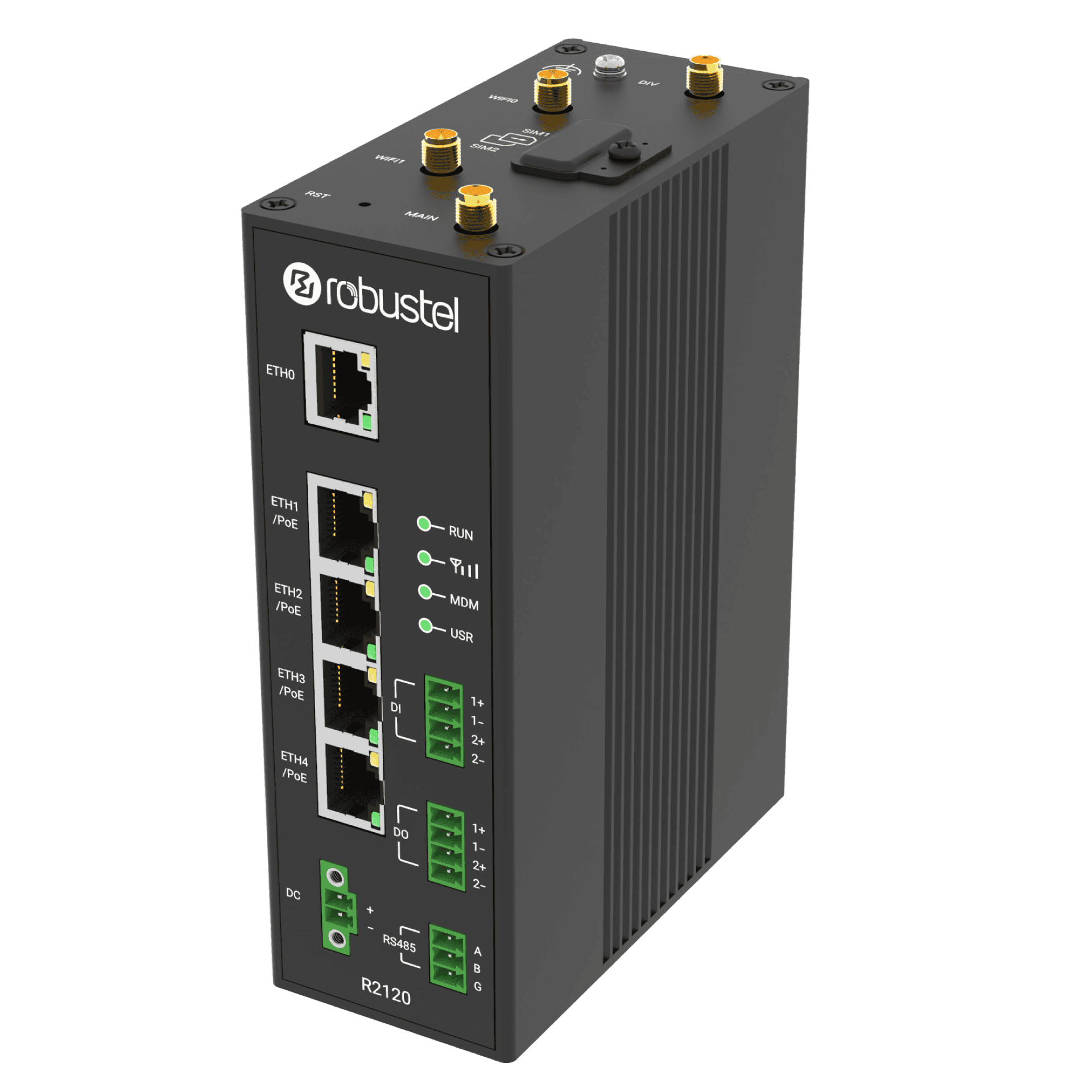
Robustel R2120 5G RedCap Industrial PoE Router
The Robustel R2120 is an industrial cellular PoE router built around 5G RedCap (3GPP Release 17) connectivity – the right tier of 5G for the applications that need it. Unlike full 5G NR, which carries cost and power overhead that most industrial IoT deployments will never use, RedCap delivers genuine 5G core network access, improved latency, and peak downlink throughput in the tens to low-hundreds of Mbps, at a device cost and power profile suited to thermally limited enclosures and field hardware.
What makes the R2120 distinctive within the RedCap hardware category is its integrated Power over Ethernet sourcing capability. Four of its five Gigabit Ethernet ports deliver PoE-PSE output at up to 30 W per port under IEEE 802.3af and 802.3at standards. That means IP cameras, access controllers, environmental sensors, and other powered field devices connect and receive power through a single Ethernet cable – no separate PoE switch, no additional power injector, and one fewer box on the DIN rail or cabinet shelf.
The router runs Robustel’s RobustOS on a Debian 11 Bullseye base, supports C, C++, Python, Java, and Node.js for custom application development, and connects to Robustel’s RCMS cloud management platform for remote monitoring, OTA updates, and PoE port power cycling from anywhere.
If you are planning infrastructure around the coming eRedCap (Release 18) standard, the R2120 sits one generation ahead of LTE and positions your hardware for network evolution. The 5G SA architecture it relies on is the same core infrastructure that will carry eRedCap devices when chipsets and modules reach market from 2026 onwards.
Key Features
- 5G RedCap primary cellular link (3GPP Release 17) with 4G LTE fallback – 5G NR bands N1/3/5/7/8/20/28/38/40/41/77/78 plus LTE FDD B1/3/5/7/8/20/28 and LTE TDD B38/40/41/42/43
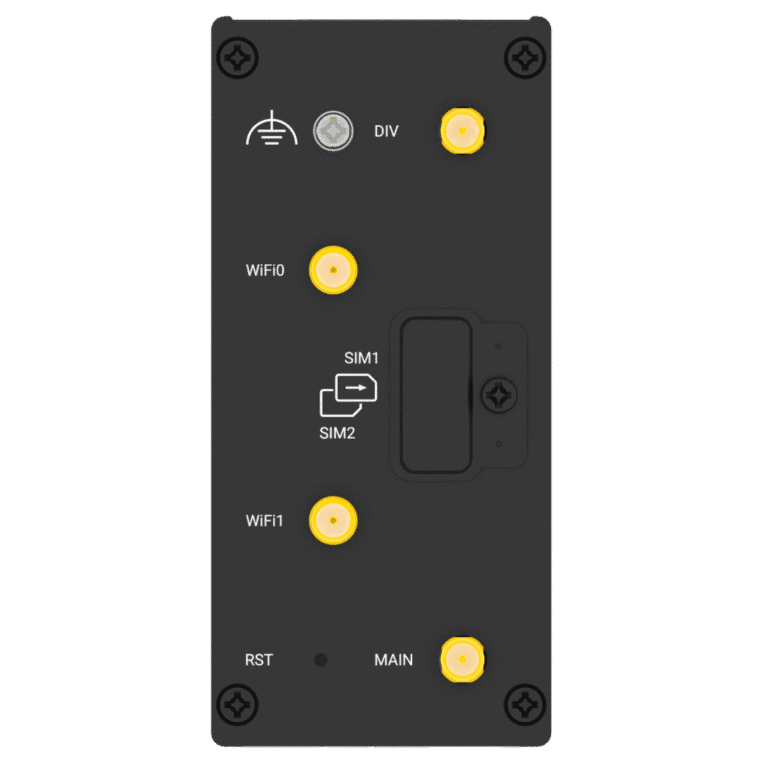
- Dual SIM (2x Mini SIM / 2FF) with automatic failover for redundant communications across two carriers or network types
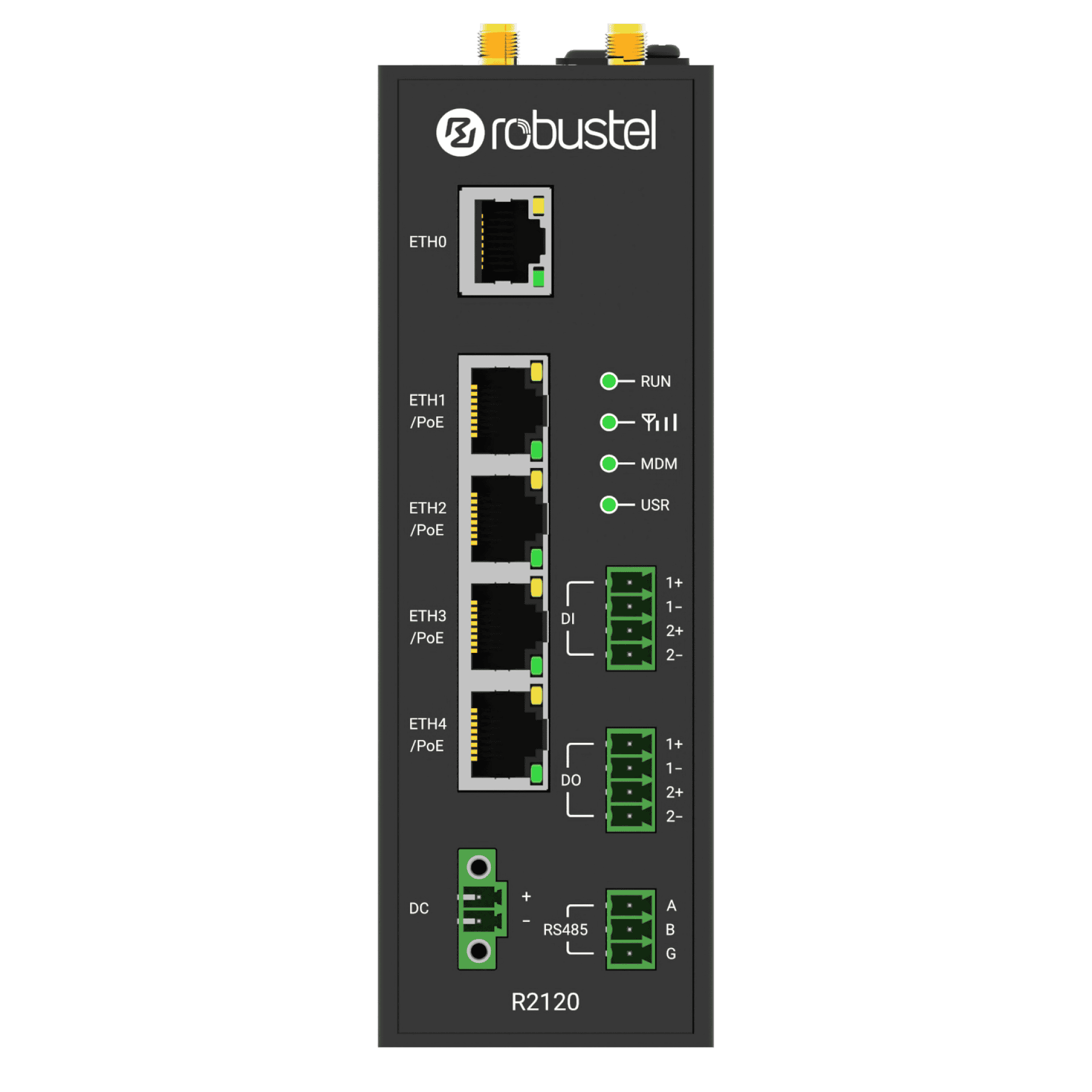
- 4x PoE-PSE ports (ETH1-ETH4) compliant with IEEE 802.3af and 802.3at, up to 30 W per port – power and data over a single Ethernet cable
- 5x Gigabit Ethernet ports (10/100/1000 Mbps) with 1 kV magnetic isolation – configurable as 5x LAN or 1x WAN + 4x LAN
- 1x RS-485 serial port with Modbus RTU to TCP bridging for legacy PLCs, RTUs, and industrial sensors
- 2x Digital Inputs + 2x Digital Outputs (opto-isolated, 3.75 kVDC) for alarm detection and direct equipment switching
- Dual-band Wi-Fi (802.11a/b/g/n/ac, 2×2 MIMO) across 2.4 GHz and 5 GHz ISM bands, AP and client modes
- VPN support including IPsec, OpenVPN, GRE, WireGuard, DMVPN, and L2TP
- RCMS cloud management with geospatial dashboard, OTA updates, and remote PoE device power cycling
- RobustOS SDK (Debian 11 Bullseye base) supporting C, C++, Python, Java, Node.js and more
- Aluminium enclosure, IP30, 539 g, 49 x 105 x 143 mm – DIN rail, wall, or desktop mountable
- Operating temperature -20 to +70 °C, CE/UKCA/RCM certified (in progress), RoHS 2.0 and WEEE compliant
What Problems Does the R2120 5G RedCap Solve?
The separate-switch problem in distributed security installations
Deploying IP cameras or access control at remote or temporary sites typically means running power separately to a PoE switch, then running data from that switch to a cellular router. The R2120 collapses both into one device. Four PoE-PSE ports at up to 30 W each handle cameras, NVRs, and door controllers directly. The 5G RedCap uplink carries the video and data traffic back. One device, one power feed, one managed endpoint in RCMS.
Legacy serial equipment stranded behind IP networks
Much of the installed base of industrial automation equipment – PLCs, RTUs, flow meters, environmental monitors – speaks RS-485 and Modbus. The R2120’s RS-485 port with native Modbus RTU to TCP bridging brings those devices onto IP networks without a separate protocol converter. Combined with the digital I/O ports for direct alarm and control wiring, it covers the full edge interface stack for a typical industrial monitoring point.
Cellular connectivity that outlasts LTE network timelines
4G LTE networks have defined sunset timelines in many markets. Designing new infrastructure around LTE-only hardware today means a potential forced refresh within the asset’s service life. The R2120’s 5G RedCap primary link – with LTE fallback for areas where 5G SA coverage is still maturing – gives installations a forward path. The UK 5G SA network is already live across EE and Vodafone, with coverage expanding.
Remote sites where engineers cannot visit for routine tasks
Scheduled restarts, firmware updates, and PoE device power cycles all require someone on site if the router cannot handle them remotely. RCMS addresses this directly – power cycling a frozen camera, pushing a configuration change, or checking signal strength across a fleet of sites is done from a dashboard, not a van. The digital outputs also enable remote switching of hardwired equipment, extending that reach to non-IP devices.
Application Areas
Industrial security and surveillance
Construction sites, industrial facilities, and public infrastructure projects need temporary or semi-permanent CCTV that goes live quickly without fixed-line provisioning. The R2120 powers up to four IP cameras directly over PoE, provides the 5G RedCap uplink for video transmission, and keeps cameras online through dual-SIM failover. RCMS handles remote PoE management so frozen or offline cameras can be power-cycled without dispatch. This maps directly to the Industrial M2M and SCADA use case, where remote visibility and control over distributed assets is a core operational requirement.
Smart city public infrastructure
Street lighting controllers, traffic management nodes, environmental monitoring sensors, and public access points all require backhaul and, in many cases, local power for connected devices. The R2120’s RS-485 port bridges legacy SCADA and monitoring protocols to the IP network, while the digital I/O handles direct alarm signalling and remote switching. 5G RedCap provides the throughput and 5G core network integration that smart city operators are beginning to specify for new infrastructure. See also: Building Management Systems.
Remote industrial monitoring and SCADA
Substations, pump stations, water treatment sites, and energy assets typically have a mix of IP and serial equipment, unreliable or non-existent fixed connectivity, and hard constraints on device count inside control panels. The R2120 consolidates cellular router, PoE switch, and serial gateway into one DIN-rail mounted unit. The 5G RedCap link with LTE fallback and dual-SIM redundancy keeps SCADA communications live even when one network is unavailable. The digital inputs monitor alarm conditions directly; the digital outputs can trigger relays or contactors. This is a natural fit for the Smart Metering and utility monitoring sectors.
EV charge point infrastructure
EV charge points increasingly require always-on connectivity for OCPP back-office communication, payment processing, and remote management. Sites without fixed-line infrastructure need a cellular backhaul that can support multiple charge points simultaneously and withstand outdoor temperature ranges. The R2120’s PoE ports can power ancillary devices – access controllers, payment terminals, site cameras – while the 5G RedCap link handles all back-office traffic. For more on the connectivity requirements in this space, see EV Charging Infrastructure.
Understanding 5G RedCap and Why It Matters for This Hardware
5G RedCap (Reduced Capability, also known as NR-Light) is defined in 3GPP Release 17. It is the first 5G device class specifically designed for industrial IoT and mid-tier applications – sitting between the LPWAN technologies (NB-IoT, LTE-M) and full 5G NR eMBB. Peak downlink throughput is typically in the tens to low-hundreds of Mbps, which is more than adequate for the data volumes that industrial gateways, security cameras, and field monitoring equipment actually generate.
Unlike full 5G NR, RedCap uses narrower channel bandwidth (up to 20 MHz in FR1), simpler antenna configurations (2×2 MIMO rather than the 4×4 or higher of eMBB devices), and reduced RF complexity – translating directly into lower chipset cost and lower power consumption at the device level.
Crucially, RedCap devices connect to the 5G Standalone (SA) core network. This gives access to 5G network slicing, the 5G security architecture (including SUPI concealment and 5G AKA authentication), and improved spectral efficiency versus LTE – capabilities that matter for operators running private networks or requiring traffic isolation across mixed-use sites.
The eRedCap standard (3GPP Release 18) takes a further step – reducing to 5 MHz channel bandwidth, single receive chain (1T1R), and half-duplex FDD operation, targeting approximately 10 Mbps peak downlink and the LTE Cat-1 replacement market. The R2120 is a Release 17 RedCap device, not eRedCap. Understanding both standards helps when selecting hardware for infrastructure with a 5-10 year service life. For a detailed comparison, see eRedCap vs RedCap.
PoE-PSE: What It Means in Practice
PoE-PSE (Power Sourcing Equipment) means the R2120 supplies power out to connected devices – it is the source, not the powered device. This is the opposite of how PoE is sometimes misunderstood.
Four of the R2120’s five Ethernet ports (ETH1 to ETH4) source power at up to 30 W per port under IEEE 802.3at (PoE+), and also support the lower-power 802.3af standard (up to 15.4 W). Total PoE power budget depends on the power supply capacity. At 48 VDC input with a 60 W adapter, the system draws 12 W for its own operation, leaving the remainder for PoE loads. For full 30 W loads across all four ports on 100 m cable runs, a 54 VDC PSU is recommended to compensate for cable voltage drop.
Practically, this means a single R2120 can power and connect: up to four IP cameras (including PTZ and IR cameras drawing up to 25 W), an NVR, an access controller, or a mix of sensors and network devices – all from one 48 V power feed, with no additional switching hardware required. Each PoE port can also be remotely power-cycled through RCMS, which handles the most common field issue with IP cameras and access controllers – a frozen or unresponsive device – without sending an engineer.
Specifications
| Cellular | |
|---|---|
| Standard | 5G RedCap (3GPP Release 17) + 4G LTE fallback |
| 5G NR bands | N1 / N3 / N5 / N7 / N8 / N20 / N28 / N38 / N40 / N41 / N77 / N78 |
| 4G LTE FDD bands | B1 / B3 / B5 / B7 / B8 / B20 / B28 |
| 4G LTE TDD bands | B38 / B40 / B41 / B42 / B43 |
| SIM slots | 2 x Mini SIM (2FF) |
| Antennas | 2 (MAIN + DIV), SMA-K connector |
| Ethernet and PoE | |
|---|---|
| Ethernet ports | 5 x 10/100/1000 Mbps (5x LAN default, or 1x WAN + 4x LAN) |
| Magnetic isolation | 1 kV |
| PoE ports | ETH1-ETH4 (4 ports) |
| PoE standards | IEEE 802.3at (PoE+), IEEE 802.3af (PoE) |
| Max PoE per port | Up to 30 W |
| Total PoE budget | Dependent on power supply capacity |
| Serial and I/O | |
|---|---|
| Serial port | 1 x RS-485, 3-pin 3.5 mm socket, 300-115200 bps |
| Serial protocols | Transparent, TCP Client/Server, UDP, Modbus RTU to TCP |
| Digital inputs | 2 x DI, wet contact, opto-isolated (3.75 kVDC), max 30 VDC |
| Digital outputs | 2 x DO, wet contact, opto-isolated (3.75 kVDC), max 30 VDC / 100 mA |
| Wi-Fi | |
|---|---|
| Standards | 802.11 a/b/g/n/ac, 2×2 MIMO, AP and client modes |
| Frequency bands | 2.4 GHz (2.412-2.472 GHz), 5 GHz (5.15-5.825 GHz) |
| Security | WPA, WPA2, WPA3, WEP |
| Encryption | AES, TKIP, WEP64 |
| Antennas | 2 (Wi-Fi0 + Wi-Fi1), RP-SMA-K connector |
| Software and Management | |
|---|---|
| Operating system | RobustOS (based on Debian 11 Bullseye) |
| SDK languages | C, C++, Python, Java, Node.js |
| VPN | IPsec, OpenVPN, GRE, WireGuard, DMVPN, L2TP, PPTP |
| Firewall | DMZ, anti-DoS, IP/domain/MAC filtering, port mapping, access control |
| Remote management | Web UI, CLI, SMS, RCMS cloud platform |
| Cloud platform | Robustel RCMS – RobustLink, RobustVPN, Operations Console |
| Network protocols | PPP, PPPoE, ARP, VLAN, ICMP, NAT, TCP, UDP, DHCP, DNS, DDNS, NTP, HTTP, HTTPS, SSH2, SMTP |
| Power | |
|---|---|
| Input voltage (with PoE) | 44-57 VDC |
| Input voltage (without PoE) | 12-36 VDC |
| Power consumption (idle) | 4.5 W @ 48 V (excluding PoE loads) |
| Power consumption (max) | 12 W @ 48 V (excluding PoE loads) |
| Recommended PSU | 48 VDC / 1.25 A (60 W) |
| Protection | Reverse polarity, surge |
| Physical | |
|---|---|
| Housing | Aluminium |
| Weight | 539 g |
| Dimensions | 49 x 105 x 143 mm |
| Ingress protection | IP30 |
| Mounting | Desktop, wall, 35 mm DIN rail |
| Operating temperature | -20 to +70 °C |
| Storage temperature | -40 to +85 °C |
| Humidity | 5-95% RH (non-condensing) |
| Certifications and Compliance | |
|---|---|
| Environmental | RoHS 2.0, WEEE |
| Regional certifications | CE (in progress), UKCA (in progress), RCM (in progress) |
| EMI | EN 55032 Class B (conducted and radiated) |
| EMS | EN 61000-4-2 (ESD), EN 61000-4-3, EN 61000-4-4, EN 61000-4-5 (Surge Level 3), EN 61000-4-6 |
| Mechanical | IEC 60068-2-6 (sinusoidal vibration), IEC 60068-2-27 (shock), IEC 60068-2-64 (random vibration) |
| In the Box | |
|---|---|
| Model R2120-A5AAA-5R-D11EU (A015000007) | 1x Router, 2x Cellular Antenna, 2x Wi-Fi Antenna, 1x Power Adapter, 1x DIN Rail Mounting Kit |
| Model R2120-A5AAA-5R-D11EU (A015000008) | 1x Router, 1x DIN Rail Mounting Kit |
Frequently Asked Questions
Is the R2120 a 5G RedCap device or a standard 4G router?
The R2120 5G RedCap (model R2120-A5AAA-5R-D11EU) uses 5G RedCap (3GPP Release 17) as its primary cellular technology, with 4G LTE as fallback. This is distinct from the standard R2120, which is LTE-only. Confirm you are ordering the 5G RedCap model code when specifying for 5G deployments. The 5G NR bands covered include N1, N3, N5, N7, N8, N20, N28, N38, N40, N41, N77, and N78.
What is the difference between 5G RedCap and eRedCap?
5G RedCap is defined in 3GPP Release 17 and targets wearables and industrial IoT with peak downlink in the tens to low-hundreds of Mbps. eRedCap (Release 18) is a further-simplified standard targeting approximately 10 Mbps peak downlink and the LTE Cat-1 replacement market – smaller channel bandwidth, single receive chain, half-duplex FDD. The R2120 is a Release 17 RedCap device. eRedCap hardware is expected from 2026 onwards as chipsets reach market.
How much power can the PoE ports supply?
Each of the four PoE-PSE ports (ETH1-ETH4) supplies up to 30 W under IEEE 802.3at. The total PoE power budget depends on your power supply capacity. The router itself draws 12 W maximum at 48 V (excluding PoE loads). With the recommended 60 W / 48 VDC adapter, the available PoE headroom is 48 W across four ports. For maximum 30 W loads per port on 100 m cable runs, Robustel recommends a 54 VDC power supply to account for cable voltage drop.
Can the R2120 bridge Modbus serial devices to IP networks?
Yes. The RS-485 port supports Modbus RTU to TCP bridging natively within RobustOS, with no additional software licence required. PLCs, RTUs, and sensors using Modbus RTU can communicate with SCADA systems and cloud platforms over the R2120’s cellular or Ethernet uplink. The port supports baud rates from 300 to 115200 bps.
Does it support 5G Standalone (SA) networks?
Yes. 5G RedCap by definition operates on the 5G Standalone (SA) core network architecture. This gives access to 5G core network features including network slicing, 5G AKA authentication, and improved spectral efficiency. The R2120 also falls back to 4G LTE on NSA or LTE-only networks where 5G SA coverage is not yet available – important for UK deployments where 5G SA coverage is expanding but not yet universal. See UK 5G SA coverage overview.
What remote management options are available?
The R2120 supports web UI, CLI, SMS-based management, and the Robustel RCMS cloud platform. RCMS provides a geospatial fleet dashboard, OTA firmware and configuration updates, signal strength and data usage monitoring, and remote PoE port power cycling. RCMS is available as a free cloud service at rcms-cloud.robustel.net.
What VPN protocols does the R2120 support?
RobustOS supports IPsec, OpenVPN, GRE, WireGuard, DMVPN, L2TP, and PPTP. DMVPN is available as an app-centre module. This covers most enterprise and utility network VPN requirements, including hub-and-spoke topologies common in SCADA and energy infrastructure.
Is the R2120 suitable for outdoor installation?
The R2120 has an IP30 ingress protection rating, which is suitable for indoor and cabinet-mounted installations but not for direct outdoor exposure without an enclosure. For outdoor deployments, mount the router inside an appropriate IP-rated enclosure. The operating temperature range of -20 to +70 °C covers the majority of UK and European outdoor cabinet environments.